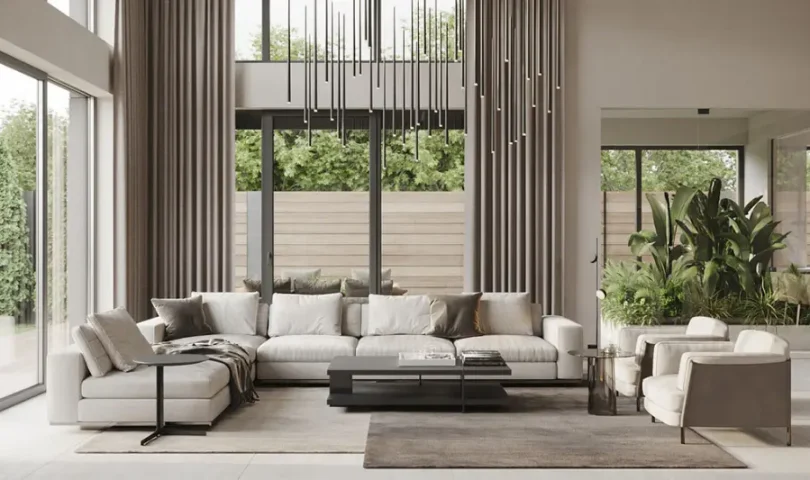

Step into a truly luxurious home and the feeling arrives before any single object does. The rooms are calm. The light is soft and deliberate. Everything seems to have space around it, and nothing seems accidental. That feeling is not bought with a single expensive sofa or a famous name on a chair. It is created by a series of design choices — about layout, materials, lighting and detail — that work together quietly. Understanding those choices is the key to creating luxury living spaces of your own, whether you are redesigning a whole house or improving one room at a time.

The encouraging truth is that exclusivity is more about intention than budget. A modest room arranged with care, finished in honest materials and lit well will feel more luxurious than a large room filled expensively and at random. The principles below are the ones interior designers return to again and again when they want a home to feel composed, personal and quietly grand.
Give Rooms Space to Breathe
The first luxury is space — not necessarily more square metres, but more room around the things you own. Crowding is the enemy of exclusivity. When furniture is pushed against every wall and every surface carries an object, the eye has nowhere to rest, and even beautiful pieces lose their impact. Editing is therefore the first design act. Keep what is useful or genuinely loved, and let the rest go.
Arrange furniture to support how a room is actually lived in. Seating should form natural conversation groups, walkways should be clear, and a focal point — a fireplace, a view, a piece of art — should organise the room around it. In luxury living spaces, layout always serves life first and appearance second, which is paradoxically why they look so good: a room that works effortlessly feels luxurious to be in.
Negative space matters in storage too. Closed, well-planned storage that hides everyday clutter is one of the most practical investments you can make. When surfaces are clear, the few objects you choose to display gain presence, and the whole home feels calmer at the end of a busy day.
Use Natural Materials With Texture and Weight
Materials are where luxury becomes physical. Stone with real veining, solid wood, linen, wool, leather, brass and plaster all have a depth and irregularity that imitations struggle to match. They also age gracefully, developing character rather than simply wearing out. A marble worktop, oak floor or linen curtain brings a sense of permanence that signals quality the moment you touch it.
Texture is how you layer these materials without visual noise. Combine smooth with rough, matte with softly reflective, heavy with light: a nubby wool throw on a leather chair, a honed stone table beside a silk cushion, limewashed walls behind polished wood. This contrast keeps a restrained colour palette interesting and is a hallmark of luxury living spaces designed to be experienced, not just photographed.
You do not need to replace everything at once. Introduce real materials gradually, starting with the things you touch most — bedding, towels, upholstery, flooring in a key room. Each upgrade raises the standard of the whole, and the mix of old and new, honestly made, often feels more personal than a room bought in one gesture.
Design Lighting in Layers
Nothing changes the mood of a home more completely than light, and nothing reveals a lack of planning faster than a single harsh ceiling fitting. Designers think in layers. Ambient light gives a room its general glow. Task light supports reading, cooking and working. Accent light draws the eye to art, architecture or a beautiful object. When all three are present and separately controlled, a room can move from bright and practical to soft and intimate in seconds.
Warmth matters. Bulbs with a warm tone flatter skin, wood and stone, while dimmers allow you to tune a room to the hour and the occasion. Natural light deserves equal attention: keep window treatments simple enough to welcome it in, position mirrors to carry it deeper into a room, and avoid blocking it with heavy furniture. Homes that manage light well feel generous even when they are not large.
Consider safety and comfort together, too. A well-lit home is a secure one, and the same care applies to the technology now woven through modern houses. If you enjoy apps and connected entertainment at home, the practical advice in our guide on how to stay safe while playing the DMPlay app is a useful reminder that the systems behind a relaxed home should be set up thoughtfully, so leisure stays leisurely.
Choose a Calm Palette, Then Add Character
Most exclusive interiors begin with a calm base: warm whites, soft neutrals, gentle greys or deep, muted tones that make a room feel cocooning rather than stark. Against that base, character comes from art, books, textiles and objects with a story, rather than from competing colours on every wall. The result is a home that feels collected over time, because much of it was.
Consistency between rooms creates the sense of a whole home rather than a set of separate experiments. Repeating a metal finish, a wood tone or a fabric family from room to room ties the spaces together, even when each has its own purpose and mood. This quiet continuity is something guests feel immediately, even if they never consciously notice it.
Personal detail is what finally separates a luxurious home from a luxurious showroom. Family photographs in good frames, travel finds, inherited pieces and books you actually read give a room a soul. Listening to the people who live in and visit a home matters here as well — as our article on feedback forms and mistakes to avoid before you start shows in another setting, gathering honest responses well helps you improve an experience instead of guessing at it. A home refined by real feedback from the people who use it will always feel better than one designed only to impress.
Finish With Craftsmanship in the Details
Exclusivity lives in details most people feel rather than see. Doors that close with a soft, solid sound. Handles and switches that have weight. Curtains that hang to the floor in a clean line. Skirting, joinery and tiling finished with precision. These are the signs of craftsmanship, and they build trust in the quality of the whole home.
Scent, sound and temperature belong to this layer as well. A home that smells faintly of good soap, wood or a signature candle, that is quiet because it is well insulated, and that is evenly warm or cool, feels luxurious in ways no photograph can capture. Attend to these invisible comforts and guests will describe your home as wonderful without quite knowing why.
Start where the effect is greatest. Edit one room until it breathes, improve its light, add one or two honest materials, and finish its details properly. Luxury living spaces are rarely created in a single renovation. They are built choice by choice, room by room, until the whole home carries the same quiet message: everything here was chosen with care, and there is nowhere you would rather return to at the end of the day.